The Acts 2020 Project
Strategic Briefing
Executive Summary
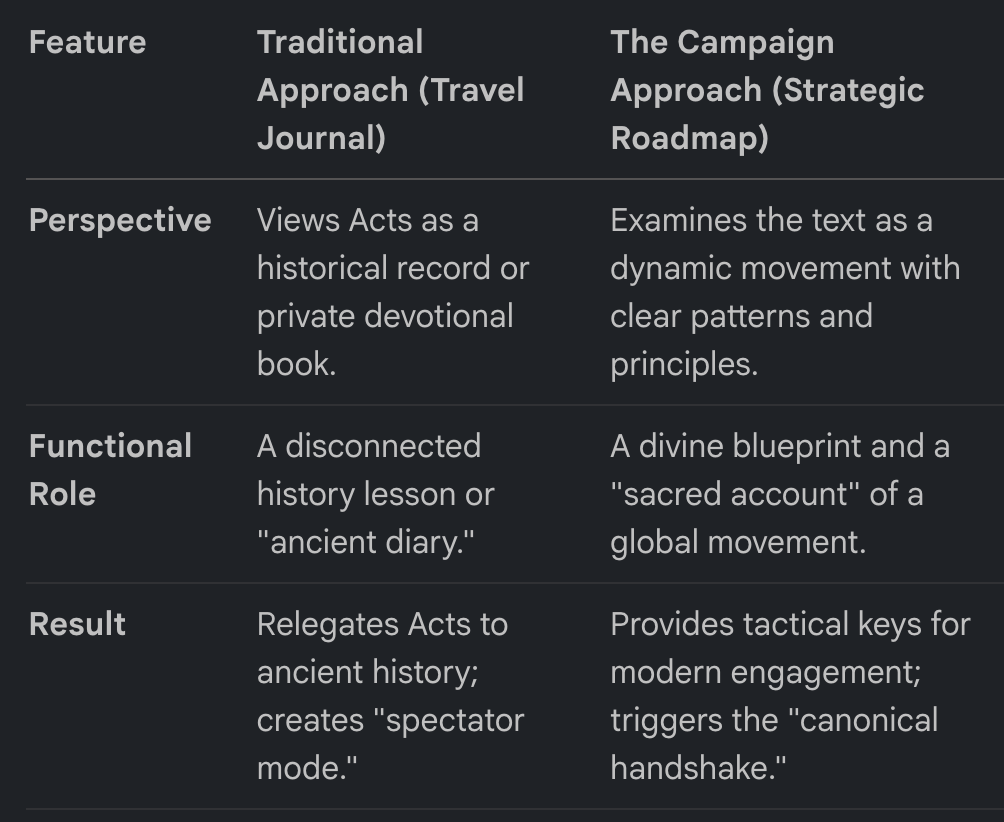
The Acts 2020 Project is a comprehensive 17-part curriculum designed to reposition the biblical Book of Acts from a historical record into a functional "Strategic Roadmap" for modern discipleship. The project argues that viewing Acts merely as an ancient diary or travel journal is a strategic error that leads to a "spectator mode" of faith. Instead, the initiative promotes a "Campaign Approach," utilizing the unchanging patterns of the first-century church to navigate the challenges of the contemporary "neo-pagan" landscape.
The project is built upon a rigorous framework of eight analytical lenses and is grounded in the consensus of thirteen world-class biblical scholars. Its primary objective is to facilitate a shift from passive feeling to active duty, equipping believers to fulfill the Great Commission through "frontline engagement" in their local communities.
The Structural Core: Reconceptualizing the Book of Acts
The project identifies a fundamental divide in how scriptural texts are interpreted and applied. To move from a "passive spectator" to an "active witness," the curriculum demands a shift in perspective:
The Canonical Handshake
The project emphasizes Acts as the "canonical handshake"—the vital link between the work of Jesus Christ and the practical, lived-out instructions found in the Epistles. It serves as the bridge that translates divine plan into human execution.
The 8 Lenses of Examination
To provide a structured framework for moving from theory to practice, the curriculum analyzes the Book of Acts through eight distinct lenses:
Lens 1: God’s Plan (The Great Commission): Traces the outward progression and expansion of the gospel.
Lens 2: The Holy Spirit (The Power Source): Documents the direct guidance and empowerment provided by the Spirit.
Lens 3: The Gospel (Telling the Story of Jesus): Focuses on the authority of the Resurrected Christ.
Lens 4: Prophecy Fulfillment (The Vertical Link): Verifies the scriptural promises that validate the mission.
Lens 5: Friction Analysis (Acceptance & Opposition): Discerns how cultural barriers and societal pressures are navigated.
Lens 6: The New Testament Bridge (The Canonical Handshake): Connects historical events to practical, instructional theology.
Lens 7: The Final Verdict (The Calculated Reality): Synthesizes facts to demonstrate the church’s designed growth.
Lens 8: Best Practices (Discipleship Today): Translates scriptural patterns into active witness in daily life.
Navigating the Modern Landscape: Friction into Opportunity
A central argument of the project is that the "neo-pagan culture" of the modern world reflects the Roman systems of the first century. Because human nature and spiritual opposition remain constant, the "scriptural patterns" found in Acts are considered universally binding and tactically relevant today.
Friction Analysis: The project teaches that societal pressures and opposition should not be viewed as roadblocks, but as "friction" that can be turned into opportunity.
Universal Duty: Discipleship is framed not as a "private feeling" but as a "shared, universally binding duty."
The Frontline: The curriculum concludes with a call to action, urging participants to exit "the pews" and use the Interactive Research Hub and workbooks to engage their neighborhoods for the gospel.