The Great Commission & The Great Commandment
What Exactly is the Great Commission?
The Great Commission serves as the formal turning point of the New Testament and the foundational mission statement for the Christian Church. Rather than polite suggestions, these passages are the authoritative mandates of a King. This strategic directive accomplishes two vital structural realities:
A New Identity: It establishes a lifelong path of apprenticeship that naturally transitions followers from the first-century title of "disciples" to the formal designation of "Christians" (at Syrian Antioch).
A Unified Strategy: It perfectly brings together the ancient promise of the Covenant, the supernatural power of the Spirit, and the absolute sovereignty of Christ.
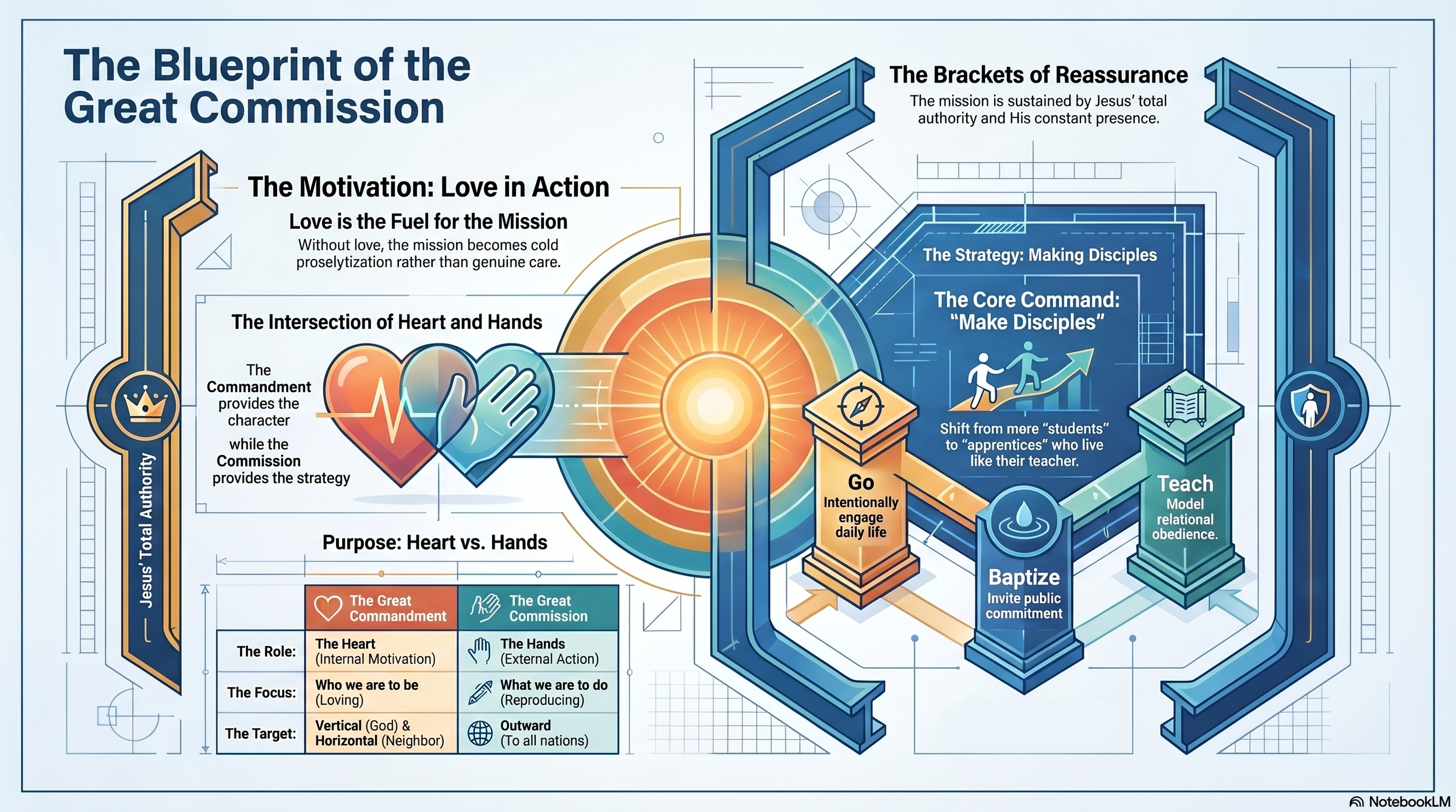
To execute this frontline mission effectively within your local church context, you must understand its exact structural layout. The Great Commission contains one primary command supported by three distinct action steps.
The Core Command: Make Disciples
As written by biblical scholars like Warren Wiersbe and Dr. John MacArthur, a disciple is not a passive student who merely memorizes facts or checks off religious traditions. A disciple is a lifelong learner who hears, understands, and systematically obeys the teachings of Christ.
Your primary directive is not merely to secure quick, superficial decisions or numbers; it is to engage in the serious, costly work of spiritual mentoring and building up committed followers of the King.
The Three Supporting Action Steps
Our 45-class deep-dive curriculum breaks down the specific mechanics of this mandate through the 8 Lenses of Examination. Through that framework, we see how the primary command is carried out:
1. "Go" (The Scope of Expansion)
The Structural Meaning: The geographic progression of the gospel—advancing from your local community to the ends of the earth—is the pre-determined plan of God.
The Action: This represents a deliberate, outward expansion. It means your faith cannot remain passive or contained inside a church building. Whether engaging with friends, relatives, or colleagues across the street or across the globe, you are moving out under a formal strategic directive issued by Christ.
2. "Baptizing Them" (The Covenantal Entrance)
The Structural Meaning: Dr. D.A. Carson and Dr. R.C. Sproul demonstrate that the command to baptize in the singular name of the Father, Son, and Holy Spirit provides the immediate blueprint for our understanding of the Trinity.
The Action: John Calvin notes that baptism is the formal, visible sign of a believer's spiritual engrafting into Christ. It serves as the covenantal seal marking a person's corporate transition into the faith community. Practically, this means moving converts out of passive isolation and publicly aligning them with the local church.
3. "Teaching Them to Obey" (The Theological Maturity)
The Structural Meaning: Jesus did not command His followers to teach abstract head-knowledge; He demanded complete submission to His ethical and theological demands.
The Action: This is the long-term, relational core of discipleship. It requires systematic teaching of the Word of God to help believers align their daily behavior, character, and worldview with the Lordship of Christ. True saving faith cannot be separated from repentance—a divinely initiated change of heart that turns away from sin to serve the living King.
The Christological Authorization
To ensure we do not falter under this heavy responsibility, Jesus brackets the Great Commission with two massive realities, anchored in historical fact:
Absolute Sovereignty: He begins by stating that all authority in heaven and on earth has been given to Him. This supreme legal standard guarantees that you move forward under His cosmic authority, not your own human talent.
Promised Presence: He concludes with the baseline promise, "I am with you always, to the very end of the age." This physical fact was validated by the infallible, physical proofs presented during His forty days of post-resurrection instruction, lifting the mission entirely out of the realm of religious myth.
The Intersection: Mechanism and Motivation
The Great Commission and the Great Commandment (Matthew 22:37–40) are entirely inseparable; one provides the structural mechanism of the frontline mission, while the other provides the spiritual motivation.
When Jesus declared that the greatest commandments are to love God completely and love your neighbor as yourself, He established the exact baseline for modern discipleship:
1. Love is the Essential Purity of the Mission
Without the Great Commandment, the execution of the Great Commission easily devolves into cold, mechanical tracking—treating individuals like projects rather than souls made in the image of God. Loving God means your desire to share His message comes from a place of genuine worship and overflow, not rigid, empty obligation. Loving your neighbor means you care deeply about their ultimate, eternal well-being.
2. A Crucial Boundary for Believers
As John Stott strongly emphasizes, the church must maintain a clear negative boundary to preserve the purity of this intersection. Social engagement, charity, and compassion are general Christian obligations under the Great Commandment. However, the specific, primary mandate of the Great Commission is the verbal proclamation of redemptive grace and repentance. We show the highest expression of love for our neighbor by prioritizing the shared resources of the gospel message.
3. Obedience is the Explicit Link
The final step of the Great Commission is teaching converts to observe all things Christ commanded. The very first and most important truth a new disciple must learn to obey is the Great Commandment. You cannot fulfill the systematic plan of the Great Commission without explicitly teaching people how to love God and love others through the power of the Holy Spirit.
Grounded in Scripture. Backed by Scholar Consensus. Driven by Truth.