Examination of the Passage
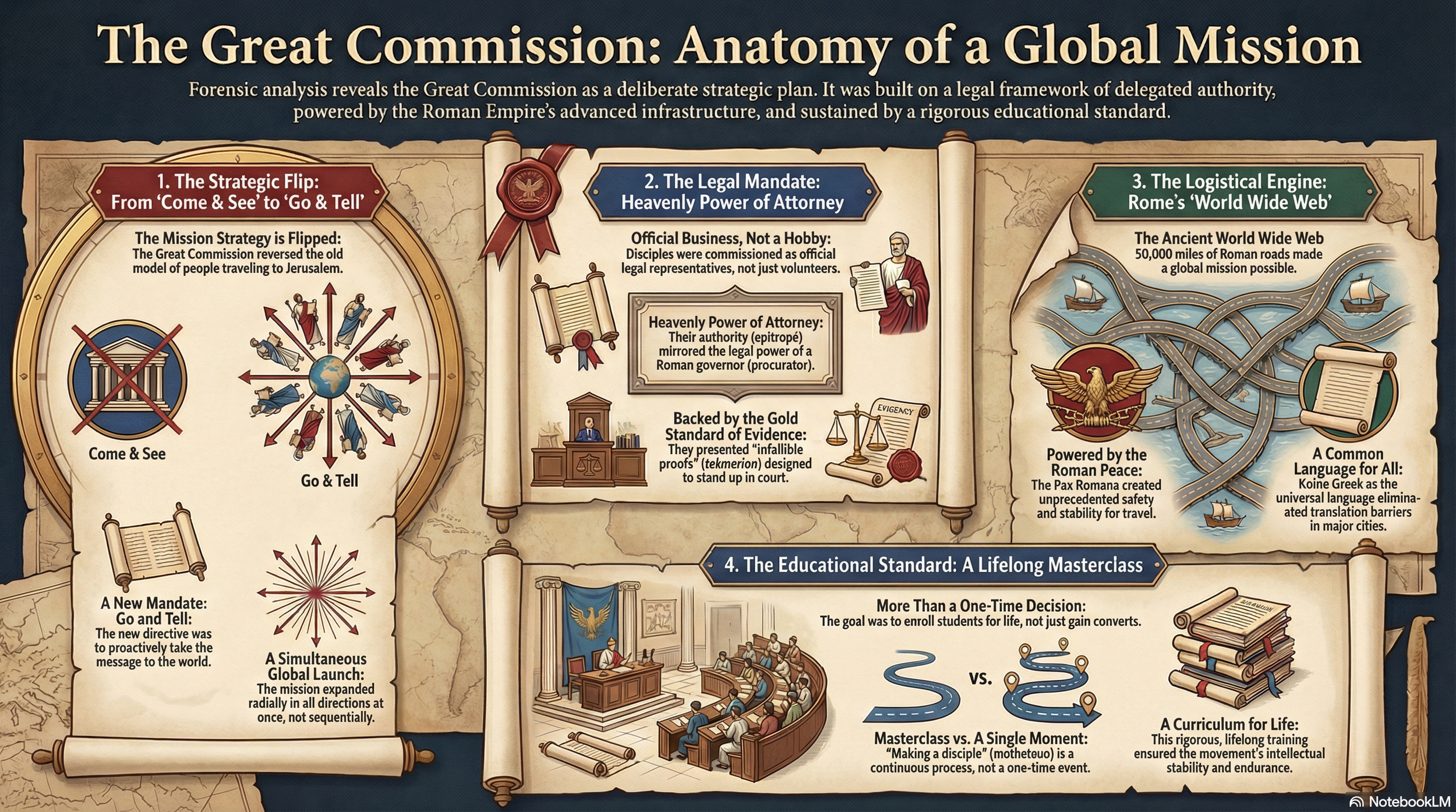
Matthew 28 and Luke 24 reveal that Jesus establishes the definitive mission for His followers. Standing on the mountain in Galilee, the Lord declares that all authority has been given to Me in heaven and on earth. This sovereign claim forms the bedrock for the command to make disciples of all the nations.
Unlike a human inheritance, this is a divine legacy requiring a specific pattern of baptizing them and teaching them to observe all that I commanded you. Jesus provides scriptural clarity by opening their minds to understand the Scriptures, proving His suffering was a necessity. He promises that the followers will be clothed with power from on high.
This marks the beginning of the proclamation of repentance for forgiveness of sins.
Eight Lenses of Examination
Through the analytical framework of Eight Lenses, we break down how the Great Commission transformed the church from a restricted witness in Israel into a global movement.
Lens 1: God’s Plan (The Great Commission)
Lens 2: The Holy Spirit (The Power Source)
Lens 3: The Gospel (Telling the Story of Jesus)
Lens 4: Prophecy Fulfillment (The Vertical Link)
Lens 5: Friction Analysis (Acceptance and Opposition)
Lens 6: The New Testament Bridge (The Canonical Handshake)
Lens 7: The Final Verdict (The Calculated Reality)
Lens 8: Best Practices (Discipleship Today)
Lens 1: God’s Plan (The Great Commission)
The primary focus of this lens is:
The outward expansion of the community from a restricted Jewish witness to a universal mission for all nations.
The fulfillment of the Abrahamic Covenant's promise to bless all families of the earth.
The authorization of the mission through the risen Lord’s sovereign authority and promised presence.
The primary directive governing both commissions is the outward expansion of the covenant community. It marks the transition from a restricted witness to a universal mission to all nations.
Dr. Darrell Bock identifies this mandate as a massive turning point for the mission. He demonstrates that the geographic progression of the gospel—beginning in Jerusalem, advancing through Judea and Samaria, and extending to the end of the earth—is the non-negotiable, pre-determined plan of God. This outward expansion is not a human design. It is not a reaction to Jewish rejection. It is the fulfillment of the Abrahamic Covenant, which always envisioned the blessing of all families of the earth.
Dr. D.A. Carson notes that the universal scope of the commission dismantles focusing only on Israel. He asserts that the local focus of Israel’s history has been replaced by the cosmic lordship of Jesus Christ. This global steps / outward movement is authorized by the supreme legal standard of the risen Lord’s authoritative command and all authority.
Dr. John MacArthur emphasizes that the disciples' obedience to the prearranged meeting on the mountain in Galilee highlights the legal and structural nature of the commission. The mountain setting serves as the formal throne room of the King. From here, He issues His sovereign decrees to His appointed representatives.
Dr. Craig Keener places this scene within a post-70 CE context. The early Jewish-Christian community was navigating the traumatic destruction of the Jerusalem Temple. They were seeking a secure theological anchor for their expanding global mission.
Dr. Joseph Fitzmyer links this global expansion directly to the theology of creation. He argues that because God is the benevolent Creator of all humanity, His redemptive plan must naturally include all the nations of the earth.
Warren Wiersbe highlights that this progression relies on absolute Christological authorization. Jesus commands His followers to rely entirely on His cosmic sovereignty and promised presence. This guarantees that the mission will succeed despite difficult obstacles. The legal standard of the mission is established by infallible, physical proofs presented during the forty days of post-resurrection instruction. These proofs elevated the resurrection out of the realm of religious myth. They placed it squarely in the court of historical fact, serving as the divine mandate that authorized the church’s global expansion.
Dr. I. Howard Marshall underscores that this authoritative plan represents the unified purpose of Luke-Acts. The historical progression of the faith is carried forward from the margins of Galilee to the center of the Roman Empire.
Learner Reflection Questions:
How does understanding the Great Commission as the fulfillment of the Abrahamic Covenant change your view of the church’s purpose?
The Meaning: This question asks you to think about the "big picture" of the Bible and realize that the mission isn't just a random task, but the completion of a promise God made thousands of years ago.
In what ways does the mountain setting as a "throne room" impact how you perceive Jesus' commands to His followers?
The Meaning: This question encourages you to consider the authority behind the mission, helping you see that these aren't just suggestions but decrees from the King of the universe.
How does the realization that the mission is "pre-calculated" by God influence your level of confidence when facing obstacles?
The Meaning: This question challenges you to reflect on whether you trust in God's sovereign plan or if you rely on your own strength, and how that trust changes your response to difficulties.
Lens 2: The Holy Spirit (The Power Source)
The primary focus of this lens is:
The Holy Spirit as the sovereign governor and strategic navigator of the global mission.
The necessity of divine empowerment before launching a universal witness.
The Spirit's role as the connector between Christ's ministry and the church's continued expansion.
The execution of the global mission depends entirely upon the sovereign governance and active empowerment of the Holy Spirit. Without Him, all human talent, strategy, and enthusiasm are just spiritual dead weight. The risen Christ issues a strict administrative directive: stay in the city until you are clothed with power from on high. John Stott highlights this spiritual equipping as the indispensable fifth dimension of the Great Commission. He explains that the disciples were strictly forbidden from launching their global witness until they received this heavenly baptism. This establishes that the Holy Spirit is the Chief Administrator and strategic navigator of the church’s mission. John Calvin provides a deep theological look at this reality. He describes the Holy Spirit as the sacred bond by which the ascended Christ effectively binds His people to Himself and communicates His heavenly blessings. Calvin insists that faith is the special work of the Holy Spirit. The outward preaching of the Word remains empty and ineffective unless accompanied by the secret, internal power of the Spirit, who opens the heart and seals the divine message.
Dr. Martyn Lloyd-Jones argues that the coming of the Holy Spirit at Pentecost serves as the final, supernatural sanction of the Church’s authority. Without this spiritual authority, the Church is reduced to a human institution with no unique power to convict or transform the world. The Holy Spirit’s role is not merely to provide emotional experiences. His role is to govern the timing, personnel placement, and theological validation of the mission. Dr. Darrell Bock and Dr. I. Howard Marshall observe that the Spirit’s administration in Acts represents the continuation of Christ's active ministry through His body, the Church. This ensures that the geographical expansion aligns perfectly with the sovereign timetable of God. The Holy Spirit’s role connects the first creation with the new creation. The same Spirit who hovered over the waters and conceived the Savior now empowers the faith community to preach repentance and forgiveness of sins in Christ's name to all nations.
Learner Reflection Questions:
How can you evaluate if your current service is empowered by the Spirit rather than human effort?
The Meaning: This question asks you to consider the difference between relying on your own skills or enthusiasm and seeking true spiritual guidance in your daily life.
In what ways does the concept of the Spirit as the "strategic navigator" change your approach to your own mission or service work?
The Meaning: This question prompts you to think about how trusting in a divine guide affects how you plan and execute your tasks compared to relying only on strategy.
Why is the internal work of the Spirit necessary for the external proclamation of the Word to be truly effective?
The Meaning: This question encourages you to explore why simply sharing information is not enough, and why a spiritual component is needed to impact the hearts of others.
Lens 3: The Gospel (Telling the Story of Jesus)
The primary focus of this lens is:
The core gospel truth centered on the physical suffering, death, and resurrection of Jesus Christ.
The distinction between the primary mandate of gospel proclamation and general social obligations.
The necessity of repentance and a radical, ethical change of life as part of saving faith.
The message entrusted to the disciples is defined by its core gospel truth: the physical suffering, death, and resurrection of Jesus Christ. It includes the consequent proclamation of repentance and the forgiveness of sins in His name. John Stott emphasizes that the primary task of the Church is to be gospel heralds. They are to publish the legal fact of forgiveness grounded exclusively in the redemptive work of Christ. Stott strongly asserts two negative boundaries to define the purity of this mission. The church is not primarily commissioned to reform society, nor is it universally commissioned to execute miraculous physical healings. Social engagement and compassion are general Christian obligations under the Great Commandment. However, the specific, primary mandate of the Great Commission is the verbal proclamation of redemptive grace.
Dr. D.A. Carson and Dr. John MacArthur align in their defense of the objective, historical, and factual nature of this gospel proclamation. The forty days of post-resurrection instruction were a historical summary based on solid evidence. Christ presented Himself through undeniable, physical proofs that established the resurrection with absolute historical certainty. This message directly challenged the existing religious and political power structures of the first century. It asserted that the crucified Jesus is the Sovereign Lord of the universe. Dr. I. Howard Marshall explains that salvation in Luke-Acts is not a vague mystical concept. It is a historical reality and a present possession, requiring a radical, ethical response. This response is defined as repentance—a divinely initiated change of mind and heart that leads to a turning away from sin and submission to the Lordship of Christ.
Dr. John MacArthur and Dr. William Hendriksen note that saving faith cannot be separated from repentance. Any presentation of the gospel that excludes the demand for turning from sin to serve the living King is a distortion that offers false assurance. The gospel commission demands a decisive change of life as well as a change of mind. John Calvin asserts that where the kingdom of Christ is truly received, the sins of all must be severely rebuked. People must give themselves up completely to the kingship of Christ in order to be cleansed and endowed with the spirit of righteousness.
Learner Reflection Questions:
How does the demand for "repentance" challenge your current understanding of what it means to follow Jesus?
The Meaning: This question invites you to reflect on whether your faith involves a genuine turning away from old habits, or if you see it as just a change in your beliefs.
Why is it significant that the Great Commission focuses on verbal proclamation rather than primarily social reform?
The Meaning: This question asks you to think about what the primary job of the church is, and why it is important to keep the gospel message at the center of that work.
How does the historical fact of the resurrection provide a foundation for challenging modern power structures?
The Meaning: This question encourages you to consider how an objective historical event, like the resurrection, impacts how Christians interact with and view the world's authorities.
Lens 4: Prophecy Fulfillment (The Vertical Link)
The primary focus of this lens is:
The vertical alignment of the Great Commission with Old Testament scripture as its foundation.
The interpretation of the entire Old Testament canon through a Christ-centered lens.
The continuity between the early church's mission and the prophetic timeline of Israel.
The vertical alignment of the Great Commission with the Old Testament scriptures is the non-negotiable foundation of its authoritative message. It proves that the New Covenant mission was pre-calculated in the eternal council of God. Jesus declares that everything written about Him in the Law of Moses, the Prophets, and the Psalms must be fulfilled. Dr. Darrell Bock emphasizes that Jesus is the exclusive topic of the entire Old Testament canon. He instructs His disciples to read and interpret the Hebrew Scriptures through a Christ-centered interpretive lens. The suffering of the Messiah, His resurrection on the third day, and the proclamation of repentance to all nations are not novel historical developments. They are the exact fulfillment of ancient prophetic scripts.
F.F. Bruce and Dr. Joseph Fitzmyer document the profound connection between the Old and New Testaments. They illustrate how the early church understood its mission as the direct realization of the prophetic timeline. Fitzmyer notes that Luke depicts the apostles as observant Christians who maintain continuity with Jewish worship and temple practices. This proves that the early church did not see itself as a break from historic Israel, but as the true, fulfilled Israel of God.
Dr. Martyn Lloyd-Jones analyzes the spiritual blindness of the disciples on the road to Emmaus. He attributes their dejection to a failure of systematic biblical interpretation. They were slow of heart to believe all that the prophets had spoken. They had selected only those prophecies predicting a triumphant, political Messiah while ignoring the parallel predictions of a suffering Servant. True vertical alignment requires submission to the entire counsel of God’s written Word, recognizing that the cross was the necessary path to the crown.
Learner Reflection Questions:
Why is it important to view the New Testament mission as a continuation of the Old Testament rather than a completely new break?
The Meaning: This question challenges you to look for connections between the past and present, helping you see the "big picture" of the biblical story.
In what ways do you currently interpret the Bible, and how might a more "Christ-centered" approach change your reading?
The Meaning: This question asks you to evaluate your own reading habits and consider how looking for Jesus in every part of the text changes its meaning for you.
Why was it necessary for the disciples to accept the "suffering Servant" prophecies alongside the "triumphant Messiah" prophecies?
The Meaning: This question asks you to think about why the Bible includes difficult or unexpected parts, and why accepting all of them is necessary for a true understanding of faith.
Lens 5: Friction Analysis (Acceptance and Opposition)
The primary focus of this lens is:
The challenge of navigating institutional and spiritual opposition while on mission.
The distinction between human hesitation (doubt) and spiritual apathy.
The sovereignty of God as the ultimate guarantee of missionary success despite external friction.
The advancement of the Great Commission is executed in highly contested and spiritually hostile environments. This inevitably provokes institutional, religious, and geopolitical friction. On the mountain in Galilee, Matthew records a critical mental or inner struggle within the apostolic community: they worshiped Him, but some doubted. Dr. Craig Keener interprets this doubt not as a flat rejection of the resurrection, but as a practical, human hesitation in the face of an overwhelming, paradigm-shattering reality. Dr. Martyn Lloyd-Jones diagnoses this dejected, hesitant state as a profound spiritual sickness that continues to plague the contemporary Church. He argues that a church characterized by sad and slow hearts—fixated on past defeats and cultural challenges rather than the victory of the resurrection—presents a compromised witness that repels the watching world. The remedy for this internal friction is to have hearts set aflame by the Holy Spirit through the systematic opening of the Scriptures.
Externally, the early church faced severe hostility from both Jewish religious authorities and Roman political systems. John Calvin notes that the proclamation of the exclusive Lordship of Christ naturally incites the rage of the world. However, this external friction is safely navigated through the sovereign execution of God’s plan of election. Calvin argues that because God has a pre-determined people whom He has chosen for salvation, the opposition of secular and religious empires cannot halt the progress of the gospel. The doctrine of election is the ultimate guarantee of missionary success. It provides the stamina and courage necessary to face persecution and martyrdom.
Calvin’s own missionary efforts in Geneva involved sending trained ministers to establish congregations in France and even as far as Brazil. He demanded that these ministers possess rigorous theological training and the necessary spiritual stamina to face potential martyrdom. This conviction was validated when at least nine of these messengers gave their lives as martyrs. Under the sovereign governance of the Spirit, even the forced scattering of believers through persecution is transformed into a divine redirection. This propels the gospel into new geographic sectors.
Learner Reflection Questions:
How can you transform obstacles in your mission into divine opportunities for redirection?
The Meaning: This question encourages you to view challenges not as signs of failure, but as chances to see how God is steering your path in a new direction.
How do you distinguish between honest human hesitation and a lack of spiritual conviction?
The Meaning: This question asks you to look inward to see if your struggles come from a normal human reaction to difficult tasks or from a lack of true belief in the mission.
How does relying on God's sovereignty change your attitude toward your own safety or comfort in ministry?
The Meaning: This question challenges you to consider if you are seeking security in your own abilities or if you are resting in the fact that God has already planned the outcome.
Lens 6: The New Testament Bridge (The Canonical Handshake)
The primary focus of this lens is:
The unbreakable theological link between the Gospels and the Epistles.
The baptismal mandate as a foundational sign of covenantal engrafting into Christ.
The New Testament Epistles as the operational manual for the local church's mission.
The events and theological mandates of Matthew and Luke establish the structural foundations for the doctrinal instructions found in the New Testament Epistles. This serves as an unbroken canonical handshake. Dr. D.A. Carson demonstrates that the command to baptize in the singular name of the Father, Son, and Holy Spirit is a profound theological development. It provides the immediate blueprint for the highly developed teachings on the Trinity and Christ in the later letters. John Calvin argues that this baptismal mandate is the formal, visible sign of our spiritual engrafting into Christ. This is a theme that Paul explains systematically in Romans 6. The sacrament of baptism seals the believer's union with Christ's death, burial, and resurrection. Dr. R.C. Sproul connects this baptismal mandate directly to New Covenant theology. He asserts that baptism serves as the covenantal seal that replaces Old Covenant circumcision, marking the corporate transition of the covenant community.
F.F. Bruce analyzes the historical bridge between the Gospels and the Epistles. He notes that the term disciple naturally transitions into the designation Christian in the book of Acts. This linguistic shift confirms that the Epistles recognize only one category of believer: a committed servant of Christ who is actively learning and obeying the King’s commands. The command to teach converts to observe all commands provides the direct legislative authority for the moral, ethical, and church instructions that fill the New Testament epistles. Dr. John MacArthur reinforces this structural continuity. He demonstrates that the epistles function as the detailed operational manual for the local church. They show assemblies how to execute the universal mandate of the Great Commission within specific local cultures and persecuted contexts.
Learner Reflection Questions:
In what ways does your baptism serve as a daily reminder of your union with Christ?
The Meaning: This question invites you to think about your faith as a permanent state of being "grafted" into Jesus, rather than just an event that happened in the past.
How can you use the Epistles to better understand the practical side of being a disciple?
The Meaning: This question asks you to move beyond seeing the Bible only as theory and to start looking at it as a practical guide for how to live and serve today.
Why is the concept of "disciple" transitioning to "Christian" significant for your own identity?
The Meaning: This question challenges you to reflect on what your title as a "follower of Christ" actually requires of you in your everyday interactions.
Lens 7: The Final Verdict (The Calculated Reality)
The primary focus of this lens is:
The meticulously calculated nature of redemptive history rather than accidental occurrence.
The local church as the essential vehicle for manifesting Christ's authority globally.
The dangers of preserving religious tradition while neglecting supernatural power.
The cumulative historical and biblical evidence demonstrates that the emergence, survival, and global expansion of the early Church was not an accidental historical event. It was a meticulously calculated reality designed by the sovereign will of God. Dr. Darrell Bock and Dr. I. Howard Marshall emphasize that the literary and theological unity of Luke-Acts proves a vital point. The progression of the gospel from a small Jewish sect to a global movement was planned with absolute historical and theological precision. Every milestone, from the geographic movements of the apostles to the outpouring of the Holy Spirit, was pre-arranged in accordance with the divine blueprint of salvation history.
Warren Wiersbe insists that the marching orders delivered by the risen King were designed to be carried out systematically by local assemblies of believers. The local church is the primary vehicle through which the cosmic authority, activity, and ability of Christ are manifested in the world. The Great Commission is not an optional program for specialized missionary societies. It is the non-negotiable, authoritative model for the existence of the Church in every age. Dr. Martyn Lloyd-Jones warns against the paralyzing effects of traditionalism, which preserves the outward forms of religion while denying its supernatural power. He asserts that the Church must continuously evaluate its alignment with the apostolic pattern of resurrection-powered, Spirit-led proclamation. The final verdict is clear: a church that does not prioritize the making of disciples is out of alignment with the sovereign blueprint of its Lord.
Learner Reflection Questions:
Is your church engagement an active mission or a spectator activity?
The Meaning: This question asks you to honestly evaluate whether you are just "watching" church happen or if you are actively participating in the mission of Jesus.
How does seeing the "big picture" of salvation history change how you view your own life story?
The Meaning: This question encourages you to see your life as a small but meaningful part of the much larger plan that God has been working out since the beginning.
How can you protect your service from becoming a routine of "empty forms" without spiritual life?
The Meaning: This question challenges you to focus on the heart and power behind your actions, ensuring that your religious habits are still fueled by a real relationship with God.
Lens 8: Best Practices (Discipleship Today)
The primary focus of this lens is:
The transition from spectator-oriented faith to active, frontline witness status.
Disciple-making as a daily, non-negotiable priority for every Christian, not a specialized program.
The requirement of complete submission to Christ's ethical and theological demands for true discipleship.
The Great Commission demands an immediate, radical shift in how contemporary believers approach their daily lives. It forces them to transition from a passive, spectator-oriented faith to an active witness status on the frontline of the church's global mission. Dr. D.A. Carson emphasizes that making disciples is the primary command. Going, baptizing, and teaching are actions that support this main goal. This structural reality means that disciple-making is not a specialized program. It is the normal, everyday priority and agenda of every local church and every individual Christian. Because the Eleven were addressed as disciples themselves, they serve as the permanent models for all future believers. Consequently, the command to reproduce other disciples is a shared and universally binding duty.
John Stott warns against the modern tendency to separate accepting Christ as Savior from submitting to Him as Lord. He insists that true discipleship requires complete submission to His ethical and theological demands. Stott acknowledges the essential combination of verbal proclamation and compassionate service. However, he maintains that verbal proclamation of the gospel message must always retain primary importance in the execution of the Great Commission. Warren Wiersbe and Dr. John MacArthur align in their definition of a disciple. They define a disciple as a lifelong learner who hears, understands, and systematically obeys the teachings of Christ. Wiersbe explains that disciple-making is a costly, arduous process of spiritual mentoring and building up. This stands in sharp contrast to the modern focus on securing quick, superficial decisions or numbers.
To implement these apostolic best practices in a highly contested, ungodly culture, local congregations must structure their ministries carefully. They must focus on the systematic teaching of the Word of God, demanding ethical holiness, public identification with Christ in baptism, and a persistent, prayerful reliance on the power of the Holy Spirit. This operational discipleship moves the believer out of passive spectator mode. It places them into an active witness status where the home, the workplace, and the local community are treated as the designated areas of the King’s sovereign steps / outward movement.
Learner Reflection Questions:
How can you shift your mindset from being a spectator in your faith to an active participant on the "frontline"?
The Meaning: This question asks you to examine your daily habits to see if you are just watching others live out their faith or if you are personally engaging in the mission.
Why is it significant that disciple-making is a shared duty for all believers, rather than a task reserved for "missionaries"?
The Meaning: This question helps you realize that you have a personal responsibility in the mission, rather than assuming it is someone else's job to share the gospel.
In what ways might "submission to Christ's ethical demands" challenge how you live your life at home or in the workplace?
The Meaning: This question challenges you to think about how your faith should change your actual behavior and choices in ordinary places, not just your beliefs on Sunday.