
The Nature of God’s Goodness
and the Reality of Human Suffering
Executive Summary
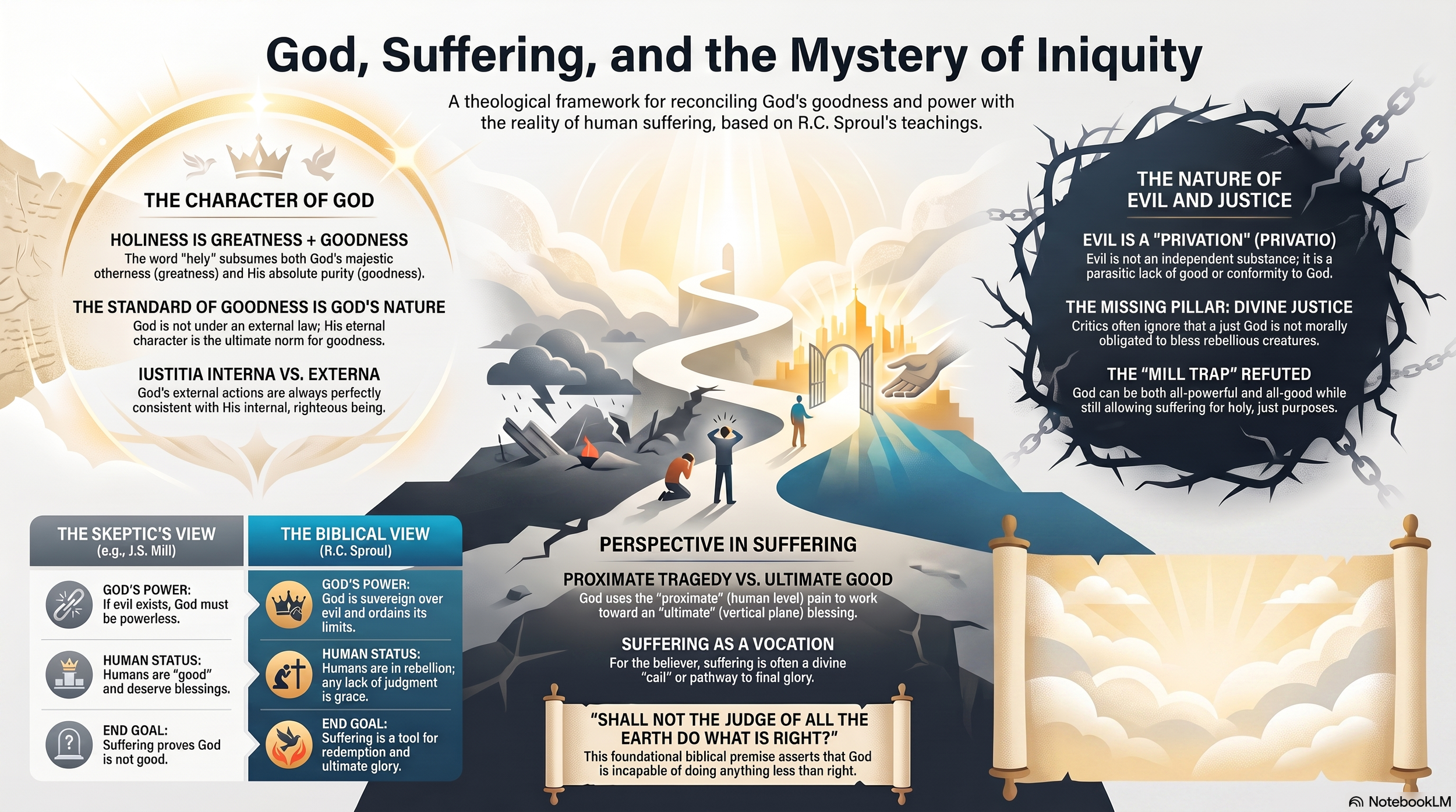
The following briefing synthesizes the theological and philosophical perspectives of R.C. Sproul regarding the intersection of divine goodness, the definition of evil, and the necessity of human suffering. Central to this analysis is the concept of God’s holiness, a term that encompasses both His transcendent greatness and His moral purity.
The core conclusions are as follows:
The Standard of Goodness: Goodness is not a standard external to God to which He must conform, nor is it an arbitrary whim. Rather, the ultimate standard of goodness is the eternal character of God Himself.
The Ontology of Evil: Evil is not an independent substance or "thing"; it is a privation or negation of the good—a parasitic reality that requires the good to exist but lacks its own ontological status.
The Problem of Pain: The classic dilemma—that an all-powerful, all-good God would not allow evil—is resolved by the inclusion of a third pillar: Justice. In a world of cosmic rebellion, the question is not why "good" people suffer, but why a holy God tolerates a rebellious creation at all.
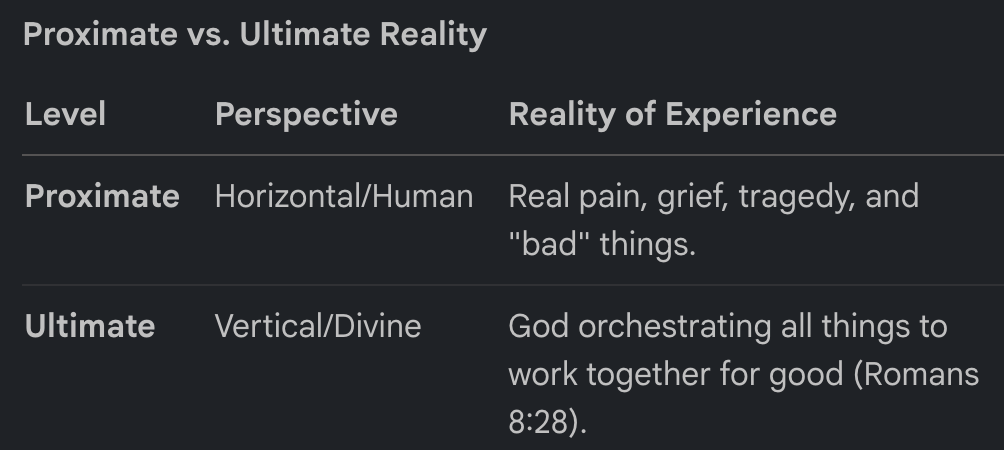
The Purpose of Suffering: For the believer, suffering is framed as a "vocation" or a call from God. While "proximate" events (illness, death, tragedy) are genuinely bad, they are "ultimately" used by God for a redemptive and good end, ensuring that for the Christian, every tragedy is eventually a blessing.
I. Defining Divine Goodness and Holiness
The concept of God’s goodness is frequently misunderstood through rote memorization or simplistic definitions. A deeper analysis reveals that goodness is inextricably linked to the attribute of holiness.
The Duality of Holiness
In sacred Scripture, the word "holy" subsumes two distinct concepts:
Greatness (Primary Meaning): Refers to God’s "otherness," His transcendent majesty, and His difference from everything in creation.
Goodness (Secondary Meaning): Refers to God’s absolute purity, characterized by a lack of blemish or shadow in His character.
The Standard of Goodness: Lex and Character
Theology historically debates whether God is subject to an independent law of goodness (sub lege) or if He is outside the law (ex lex), acting arbitrarily. Orthodox Christianity rejects both:
Internal Righteousness (Iustitia Interna): This is God’s inherent purity of being.
External Righteousness (Iustitia Externa): This is God’s outward action, which is always perfectly consistent with His internal nature.
Conclusion: God is a "law unto Himself." He acts according to His nature, which is the ultimate norm for goodness.
II. The Ontology and Origin of Evil
Defining "what" evil is provides the necessary groundwork for understanding "where" it came from.
Evil as Privation and Negation
Evil does not possess "being" or an independent existence. It is defined using two Latin concepts:
Negatio (Negation): Evil is the opposite of a positive affirmation (e.g., injustice as the negation of justice).
Privatio (Privation): Evil is a lack or deficiency of something necessary (e.g., sin as a "want of conformity" to God’s law).
The Parasitic Nature: Like a parasite, evil depends on a "host" (the good) for its existence. If the good were removed, evil would vanish, as it has no independent strength.
The Problem of the Origin of Evil
Explaining the entrance of evil into a universe ruled by a holy God is termed the Achilles’ heel of Christianity.
The "Free Will" Limitation: While moral evil is enacted through the choices of creatures (Adam, Eve, Lucifer), a choice requires a prior inclination. If God created these beings "good," the source of a prior inclination toward evil remains a "mystery of iniquity."
The "Impossible Possibility": Theologian Karl Barth described the origin of evil as a contradiction: it had to be possible because it happened, yet logically, it seems impossible for a perfectly good being to develop an evil desire.
Rejection of Finitude: The argument that sin is an inevitable consequence of being a finite creature (Leibniz) is rejected, as it would make God the author of evil and provide an excuse for human sin.
III. Re-evaluating the "Problem of Pain"
The philosopher John Stuart Mill argued that if God were all-powerful and all-good, He would eliminate evil. Since evil exists, Mill concluded God must lack either power or benevolence.
The Missing Pillar: Divine Justice
The "Mill Trap" fails because it ignores Justice. The argument assumes God is morally obligated to provide nothing but blessing to His creation.
Cosmic Rebellion: Humanity exists in a state of "cosmic treason." If a just Judge gave only rewards to traitors, that Judge would be corrupt.
The "Good People" Fallacy: To the question "Why do bad things happen to good people?", the biblical answer is: "They don't." Scripture asserts that "none is righteous," and therefore, by the ultimate standard of God’s goodness, there are no "good people."
The Negotiation of Abraham
In Genesis 18, Abraham questions if God will "sweep away the righteous with the wicked" in Sodom. This narrative establishes that God will never punish the innocent with the guilty; in fact, He expresses a willingness to be gracious to the wicked for the sake of the innocent (agreeing to spare the city for the sake of ten righteous people).
IV. Suffering as a Vocation
The Christian perspective on suffering distinguishes between the "proximate" (human level) and the "ultimate" (divine level).
The Via Dolorosa: The road to redemption was paved through the suffering of Christ (the "Man of Sorrows"). Consequently, participation in Christ’s glory is conditional upon participating in His suffering.
Redemptive Purpose: Just as the "blackest act in history" (the Crucifixion) resulted in the ultimate good, God uses the suffering of believers for holy and redemptive purposes.
The Believer’s Assurance: While the world is a "vale of tears," the Christian is promised that God will eventually "wipe away every tear," and that present sufferings are "not worthy to be compared with the glory that will be revealed."
V. Key Insights and Perspectives
"Shall not the Judge of all the earth do what is right?" — Abraham (Genesis 18:25)
The Paradox of Ordained Evil: While evil is not good, it is good that there is evil; otherwise, it would not exist in a universe ruled by a sovereign God. God ordains it in a way that He uses it for holy purposes without being the author of the sin itself.
The Burden of the Unbeliever: While the believer struggles with why evil exists, the unbeliever has a harder problem: accounting for the existence of good without a source of goodness.
The Nature of Grace: Every second a human being exists free of punishment is an act of "grace and grace alone." The question should not be "Why me?" in suffering, but "Why me?" in the reception of any blessing.
Final Triumph: Though the origin of evil is a mystery, its future is certain. It has been overcome by Christ and will eventually be eradicated from the universe in the "new heaven and new earth."