
Examination of the Passage
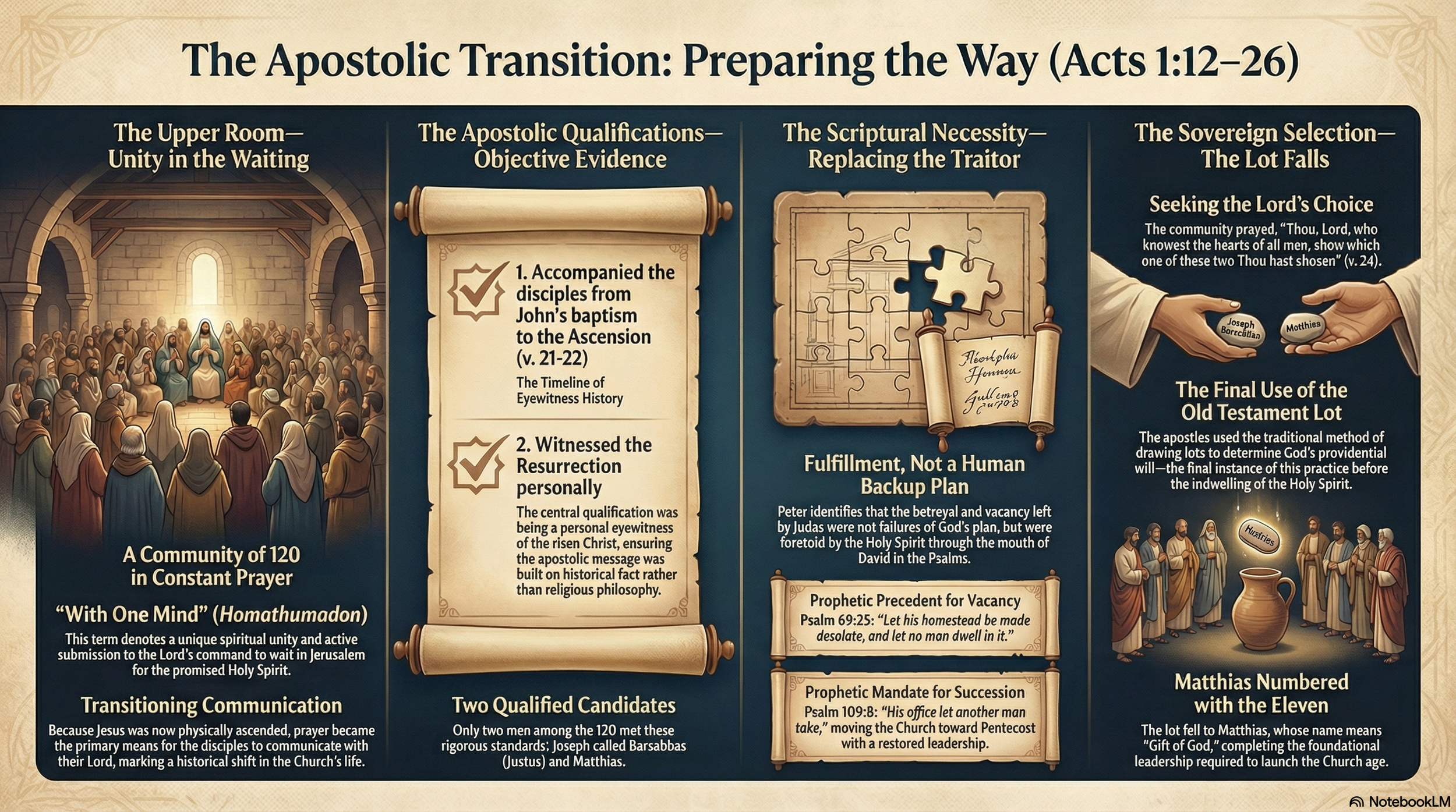
Acts 1:12–26 reveals that the first community of believers practiced total submission following the Lord's departure. After traveling a Sabbath day’s journey from the mount called Olivet, the eleven remaining apostles, the women, and the biological brothers of Jesus gathered in an upper room. These individuals remained with one mind while continually devoting themselves to prayer. This period of waiting was not passive but foundational, as Peter recognized that the Scripture had to be fulfilled regarding the betrayal of Judas. By establishing strict requirements for a witness of His resurrection, the group ensured that the foundation of the coming church remained structurally sound. Under the Lord's sovereign direction, the group drew lots to select Matthias, who was then numbered with the eleven apostles. This transition highlights Jesus’s care in securing the right men.
To engage in a thorough Q&A with Dr. MacArthur's research, see “Ask John” section below.
Lens Presence
Lens 1: God’s Plan (The Great Commission) Dr. MacArthur identifies this transition as the final preparation for the mission's start. The selection of Matthias ensured the apostleship was complete to fulfill the task of evangelizing the world. MacArthur emphasizes that Jesus chose Matthias just as surely as He chose the original eleven.
Lens 2: The Holy Spirit (The Power Source) The Spirit is revealed as the divine author who foretold by the mouth of David the specific details regarding the traitor. MacArthur notes that the coming of the Holy Spirit was a sovereign promise of God that did not depend on human prayer, though the believers waited in a posture of dependence.
Lens 3: The Gospel (Telling the Story of Jesus) The central requirement for the new apostle was to be a witness of His resurrection. MacArthur argues that this personal eyewitness testimony regarding the Lord Jesus is the non-negotiable core of the apostolic message.
Lens 4: Prophecy Fulfillment (The Vertical Link) Peter utilizes the book of Psalms to prove that the homestead of the traitor must be made desolate and his office taken by another. This alignment with the Old Testament "paper trail" verifies that the mission was pre-calculated and not an afterthought following a human crisis.
Lens 7: The Final Verdict (The Calculated Reality) The shift from the Sabbath day’s journey and the use of lots to the age of the indwelling Spirit proves the mission is a Calculated Reality. MacArthur concludes that with the selection of Matthias, the final resource (12th Apostle) was provided for the birth of the church.
Investigative Questions
"Ask John"
The primary discovery in this briefing is the absolute sovereignty of God in managing the personnel and timing of the early church. Dr. MacArthur demonstrates that the transition from Judas to Matthias was a divinely orchestrated fulfillment of ancient prophecy rather than a human reaction to a failed plan.
Lens 1: God’s Plan (The Great Commission)
How does the requirement for the candidate to have accompanied the group from the baptism of John protect the historical integrity of the mission?
Why was it necessary for Matthias to be numbered with the eleven apostles before the work of the Great Commission could begin in earnest?
Lens 2: The Holy Spirit (The Power Source)
In what way did the Holy Spirit provide the specific details of the betrayal long before Judas turned aside to his own place?
How does the fact that the believers were continually devoting themselves to prayer demonstrate their total dependence on the promised power?
Lens 3: The Gospel (Telling the Story of Jesus)
Why is being a witness of His resurrection the primary qualification for anyone seeking to occupy this ministry?
How does the historical account of Judas falling headlong and being burst open in the middle validate the physical reality of the consequences of rejecting the Lord?
Lens 4: Prophecy Fulfillment (The Vertical Link)
How does the phrase the Scripture had to be fulfilled reassure the believers that the mission had not been derailed by treachery?
Which specific passages in the book of Psalms provided the legal and historical standing for the selection of a disciple?
Lens 7: The Final Verdict (The Calculated Reality)
How does the final use of lots in the New Testament record signify the completion of Jesus’s preparation for the new age?
Why does the fact that the group was gathered with one mind serve as evidence of the Calculated Reality of the church's foundation?