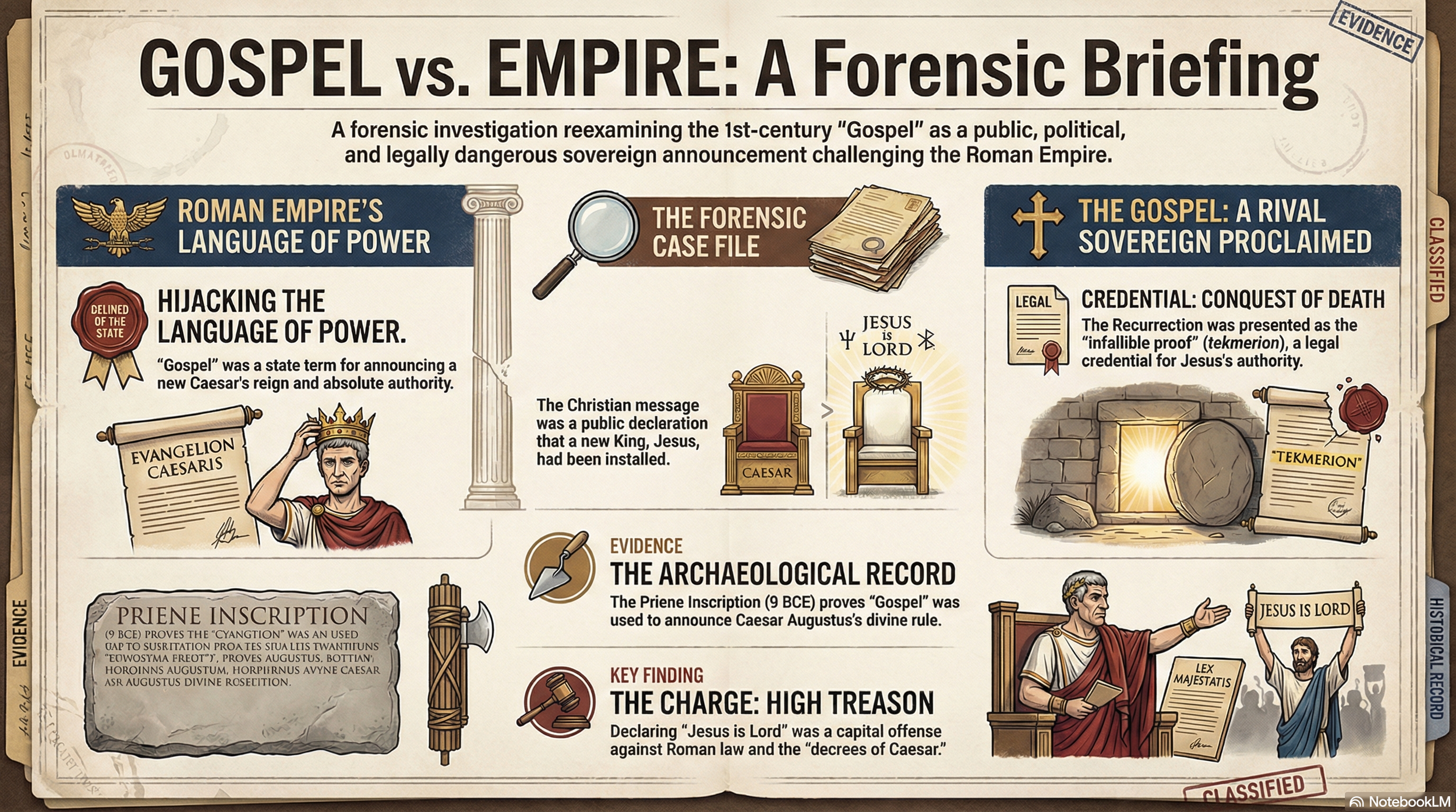
The Briefing Note:
Lens 3: Teaching About Jesus (The Announcement of a New Sovereign)
This Lens frames the Gospel message as a "High-Stakes Sovereign Announcement" that directly challenged the Roman Empire and the cult of Caesar. The term used, euangelion ("good news" or "Gospel"), was originally a political term used to herald the birth, victories, or enthronements of the Caesar. By using this language, the Apostles were launching a campaign of imperial sedition, declaring a rival sovereign: Jesus Christ. To challenge the Emperor, this claim required a legal credential. That credential was the Resurrection. The Gospel was presented as infallible proofs (tekmerion)—a demonstrative proof that leads to a logically necessary conclusion. Caesar claimed power through military conquest; Jesus claimed power by conquering death itself. By overcoming the cross, the ultimate expression of state power, Jesus demonstrated a "sovereign exception" to the physical system. The public confession Jesus is Lord (Kyrios) was a deliberate, treasonous act. In Roman colonies, Kyrios was reserved for the Emperor. Applying it to a crucified man was considered treason (maiestas). This explains the intense opposition in places like Thessalonica, where Apostles were accused of "acting contrary to the decrees of Caesar, saying that there is another king, one Jesus". This referenced Roman laws against unauthorized predictions regarding the state’s fate. The Gospel wasn't a request for religious tolerance; it was a declaration of sovereign victory, asserting that the deified Caesars were superseded by the King who returned from the dead.
Note: “The 8 Lens of Examination” framework is a proprietary method of analysis created by the Acts 2020 Project.