
The Pattern: Persistence in the Face of Persecution
Acts 4:1-31
I. The Executive Summary: "The Inescapable Truth"
When the power of the Gospel disrupts the religious and political status quo, institutional persecution is the inevitable result. In Acts 4, we see the first official attempt to silence the Church. The "Inescapable Truth" revealed here is that the believer's response to intimidation is not retreat or legal maneuvering, but a deeper reliance on the Holy Spirit and a bold re-assertion of the exclusive Lordship of Jesus Christ.
II. The Forensic Map (Acts 4:1–31)
Phase I: The Institutional Arrest
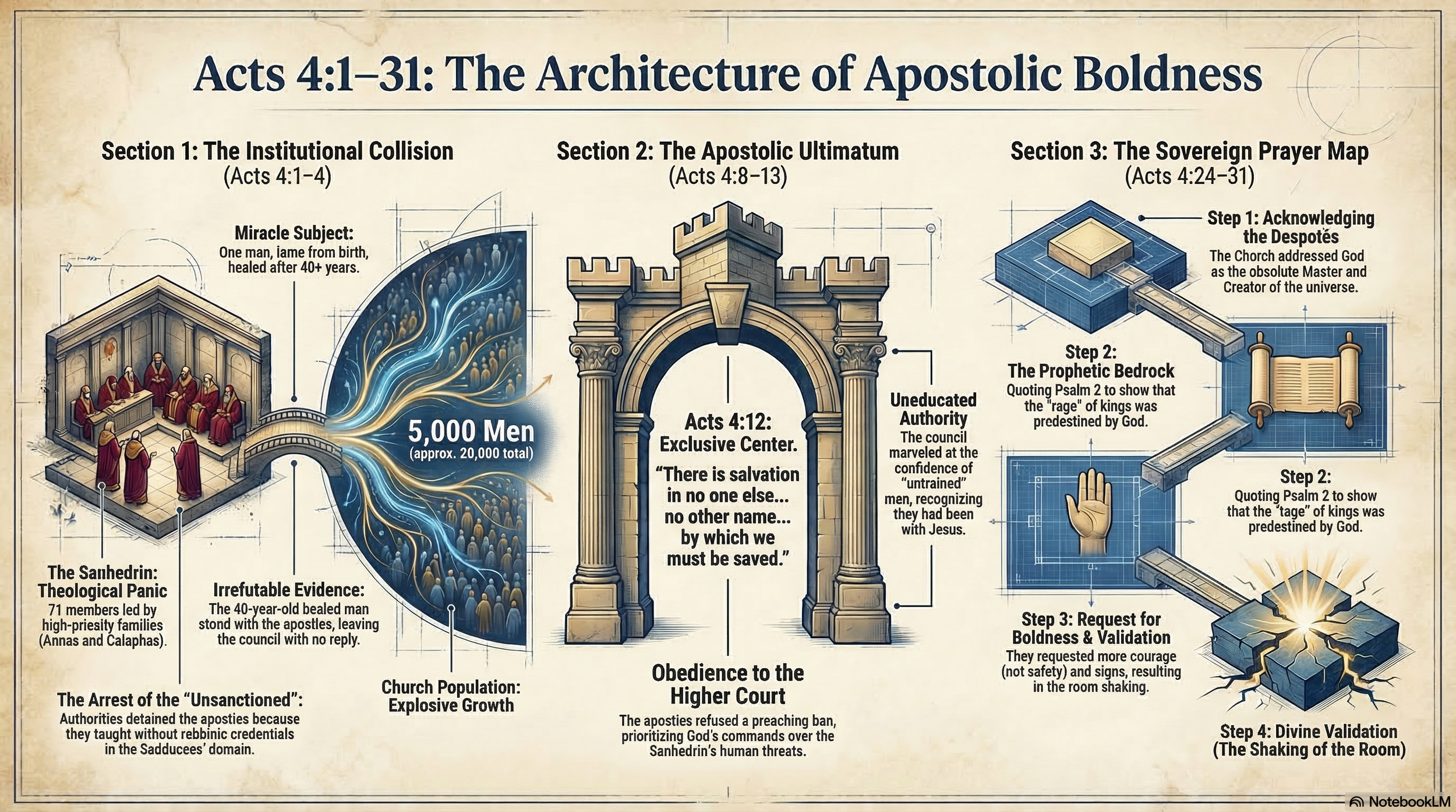
As Peter and John spoke, the Sadducees—the religious elite who denied the resurrection—became greatly disturbed. They utilized their legal authority to arrest the Apostles, yet the forensic impact of the previous miracle could not be undone: “But many of those who had heard the word believed; and the number of the men came to about five thousand.” (Acts 4:4).
Phase II: The Apostolic Ultimatum Brought before the high-priestly family, Peter—filled with the Holy Spirit—refused to offer a defensive plea. Instead, he presented a forensic indictment of the council, declaring that the stone they rejected had become the head of the corner and asserting: “Neither is there salvation in any other: for there is none other name under heaven given among men, whereby we must be saved.” (Acts 4:12).
Phase III: The Sovereign Providential Response After being threatened and released, the Apostles did not pray for safety; they prayed for boldness. They recognized the persecution as a fulfillment of the “Prophetic Bedrock of Psalm 2. The result was a physical manifestation of divine approval: ”And when they had prayed, the place was shaken where they were assembled together; and they were all filled with the Holy Ghost, and they spake the word of God with boldness. (Acts 4:31).
III. The Intelligence Source (MacArthur Synthesis)
The Sadducean Motive: Dr. MacArthur identifies that the Sadducees were motivated by a "theological panic." Because they did not believe in the resurrection, the Apostles' message regarding a Risen Christ was a direct threat to their entire religious system and political stability.
The Power of Plainness: The council was astonished at the "unlearned and ignorant" nature of Peter and John. The research highlights that their power did not come from rabbinical training but from the forensic fact that they “had been with Jesus. (Acts 4:13).
The Theology of Prayer: The prayer in verses 24-30 is a masterclass in sovereignty. The Apostles did not ask God to stop the persecution; they asked for the enablement to fulfill their mission through the persecution, recognizing that their enemies were only doing what God's hand and counsel had “determined before to be done. (Acts 4:28).
IV. The Tactical Pivot: From Pattern to Practice
You have examined the record of the first official conflict between the Church and the State. You have seen how the Apostles used the "Apostolic Ultimatum" to silence their accusers.
How does Peter’s refusal to yield to a "legal gag order" provide the blueprint for 21st-century believers facing legislative hostility?
How do we utilize the Logic Lens to maintain our witness when threatened with social or legal consequences?
[BUTTON: ENTER THE ACTS EVANGELISM WORKBOOK]
Investigative Questions:
Persistence in the Face of Persecution (Acts 4:1–31)
The primary discovery of this passage is the Church’s transition from public wonder to official institutional conflict. These queries help the student explore the Apostolic response to legal intimidation and the sovereign framework of prayer using the "Ask John" Hub.
Lens 2 (The Holy Spirit's Role)
Question 1: How does being “filled with the Holy Ghost” (v. 8) serve as the forensic requirement for Peter’s specific ability to address the Sanhedrin with boldness rather than a legal defense?
Lens 3 (The Message)
Question 1: In what way does the "Apostolic Ultimatum" of verse 12—”neither is there salvation in any other”—establish the exclusive "Name" as the primary trigger for institutional hostility?
Question 2: How does the "Theological Panic" of the Sadducees regarding the resurrection (v. 2) provide the evidence for why the Gospel is inherently disruptive to secular and religious power structures?
Lens 4 (The Foundation)
Question 1: Why is the citation of “the stone which was set at nought of you builders” (v. 11/Psalm 118) the most critical piece of evidence to convict the high-priestly family of their own prophetic failure?
Question 2: How does the Apostles' use of Psalm 2 in their prayer (v. 25-26) serve as the Prophetic Bedrock for categorizing their current persecution as a pre-determined event in God’s sovereign plan?
Lens 6 (The New Testament Bridge)
Question 1: How does the Apostles' refusal to obey the "legal gag order" (v. 19-20) establish the biblical bridge to the Epistles' teachings on the hierarchy of authority and the necessity of obeying God rather than men?
Question 2: In what way does the "shaking of the place" (v. 31) serve as a physical landmark of divine approval, mirroring the future expectations of the Spirit’s power in the life of the persecuted church?