
Acts Evangelism Workbook:
Lesson #1 (Acts 2:1-47)
Confronting the Mockery of Naturalism
The Tactical Briefing: The 30,000-Foot View
In Acts 2, the Church is not "introduced" to the world through a friendly social program. It is launched via a Divine Tactical Maneuver. Before a single word of the Gospel was preached, the Holy Spirit empowered 120 believers to seize the intellectual high ground by declaring the majestic attributes and historical acts of Jehovah.
When this supernatural power was manifested, the immediate response of the 1st-Century "Neo-Pagans" was not wonder, but naturalistic mockery. They attempted to explain away the miraculous with a physically impossible excuse: "These men are full of new wine." (Acts 2:13).
The Cultural Discernment: 1st Century vs. 21st Century
The 1st-Century Landscape:
A pluralistic crowd gathered for a religious festival. Faced with "uneducated Galileans" fluently praising God in foreign dialects, the skeptics defaulted to "mockery" to protect their worldview from the obvious supernatural reality.The 21st-Century Parallel:
Today’s secularist uses the same "Naturalistic Firewall." When faced with the historical claims of Christ or the changed lives of believers, they default to "psychological projections" or "evolutionary biology" or disparagement They mock because they cannot account for the Forensic Evidence.The Strategy of the "Mighty Deeds":
The believers were “speaking in our tongues the wonderful works of God.” (Acts 2:11). This was a brilliant tactical opening. By strictly praising God, they forced the mockers to admit the power was divine—as Satan would never inspire the praise of the true God. This "prepared the soil" for Peter to pivot from their mockery to a forensic defense.
Evangelism Briefing #01:
The First Defense & Harvest (Acts 2:14–41)
I. Engagement Overview
The Target: A cynical, mocking crowd dismissing a supernatural event as "drunkenness".
The Catalyst: The audible and visual manifestation of the Holy Spirit (The Sign) that creates a public "Crisis of Interpretation".
II. The "How" (Execution Tactics)
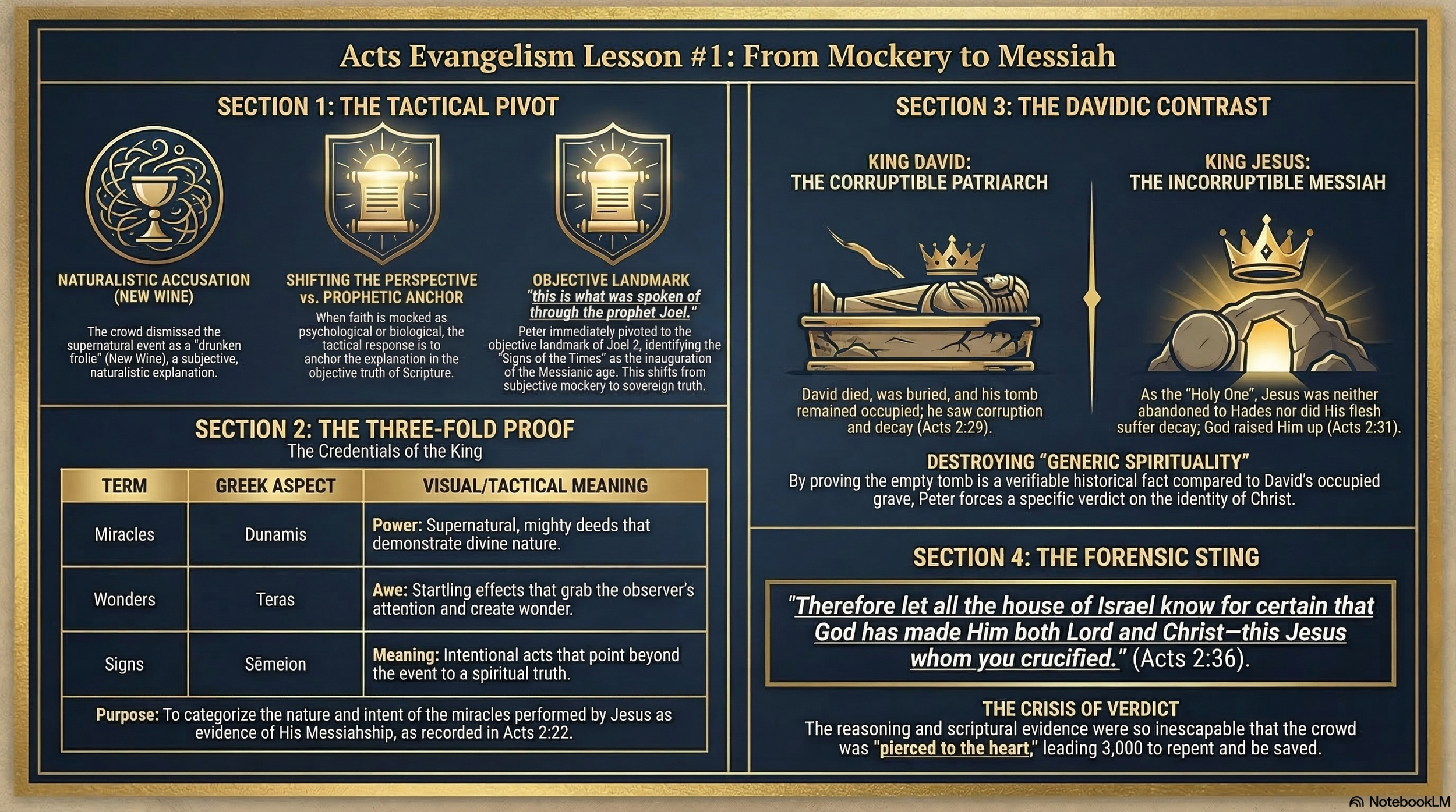
The Prophetic Anchor (v. 14–16): Peter ignores the emotional weight of the mockery and anchors the event in the Word: "but this is what was spoken of through the prophet Joel".
21st Century Application: When the world mocks your faith as psychological or biological, do not get defensive. Pivot immediately to the Objective Landmark of Scripture to explain the world's condition.
The Evidentiary Credentials (v. 22): Peter cites the public record of Jesus: "Jesus the Nazarene, a man attested to you by God with miracles and wonders and signs which God performed through Him in your midst, just as you yourselves know".
21st Century Application: Use "shared history" and the Historical Specificity of Christ's life. Challenge the skeptic with facts they cannot easily dismiss.
The Closing Call (v. 38–40): Transitioning from indictment to invitation with a direct command: "Repent, and each of you be baptized in the name of Jesus Christ" and a plea for separation: "Be saved from this perverse generation!".
21st Century Application: Do not just "invite" people to a meeting; call them out of a "Crooked Generation." Move the seeker from a mental verdict to a physical commitment through repentance.
III. The "Why" (Strategic Objectives)
Logic over Naturalism: To move the crowd from a naturalistic explanation (wine) to a sovereign one (the Spirit).
The Davidic Contrast (v. 29–34): Peter uses a side-by-side comparison of King David and King Jesus to prove the Resurrection.
The Logic: By proving David is still in his tomb while Jesus is exalted, he removes all "Generic Spirituality" and forces a Crisis of Verdict regarding the identity of Christ.
The Harvest Pattern (v. 37–41): The final objective is Conviction leading to Expansion. The "Why" of the entire sermon is to bring an audience to be "cut to the heart" so that 3,000 souls may be added to the church.
NOTE:
The following sections contain examples of content
that will be developed into a separate workbook for “Acts-based Evangelism”.
Research Assignments (Using the Hub)
Use these questions in the Hub to read Dr. MacArthur’s discussions about this confrontation.
Assignment 1: The Tactical Purpose of Praise (v. 2:11)
Concept: The crowd heard the believers speaking of the mighty deeds of God (Acts 2:11) before they heard the Gospel of Christ.
Hub Prompt:
"In Acts 2:11, why was it a 'brilliant tactical maneuver' for the 120 to be praising Jehovah's historical acts instead of preaching the Cross immediately? How did this 'prepare the soil' for Peter's sermon?"
Assignment 2: The "Sweet Wine" Logic Gap (v. 2:13)
Concept: The mockers claimed the believers were full of new wine. (Acts 2:13). This was a sarcastic jab, implying they were intoxicated on unfermented "baby juice."
Hub Prompt:
"Why was the 'sweet wine' accusation in Acts 2:13 a 'culturally impossible' and 'factually ridiculous' charge, and how did Peter use the 'third hour of the day' to destroy this logic?"
Assignment 3: The Vertical Link (v. 16-21)
Concept: Peter links a current physical event to an ancient prophetic text (Joel 2).
Hub Prompt:
"Why was it tactically necessary for Peter to quote Joel 2 to a skeptical audience, and how does this help us answer the 'Naturalistic Mockery' of 21st-century skeptics?"
Assignment 4: The Empty Tomb vs. The Occupied Tomb (v. 29-32)
Concept: Peter points to the physical grave of King David to prove the Resurrection of Jesus.
Hub Prompt:
"Explain the 'Forensic Contrast' between the tomb of David and the tomb of Jesus in Peter's sermon. Why is this historical evidence the 'Inescapable Conclusion' of his message?"
Application
The Scenario: A skeptic tells you, "The Bible is just a collection of ancient myths used to control people. It has no basis in the real world."
Your Task: Using the Logic Lens, draft a response that pivots from their "mockery" to a "Forensic Fact" regarding the "Mighty Deeds of God."
One Answer:
The Script: > "I understand why you might see it as a myth if you view it as just a set of 'religious stories.' But the Bible doesn't ask for blind 'religious feeling'; it points to the mighty deeds of God (Acts 2:11)—events anchored in geography and eyewitness history. If the Resurrection of Jesus is a myth, then the witnesses were either liars who died for a lie, or they were 'full of new wine' (intoxicated by a delusion). But the forensic evidence—the empty tomb and the transformed lives of the Apostles—makes the 'myth' explanation logically impossible. Have you ever audited the historical evidence for the Resurrection itself?"
The Strategy: This response identifies the skeptic's "myth" charge as a form of modern "sweet wine" mockery. It ignores the insult and shifts the burden of proof back onto the skeptic to explain the Forensic Facts of history.