
Examination of the Passage
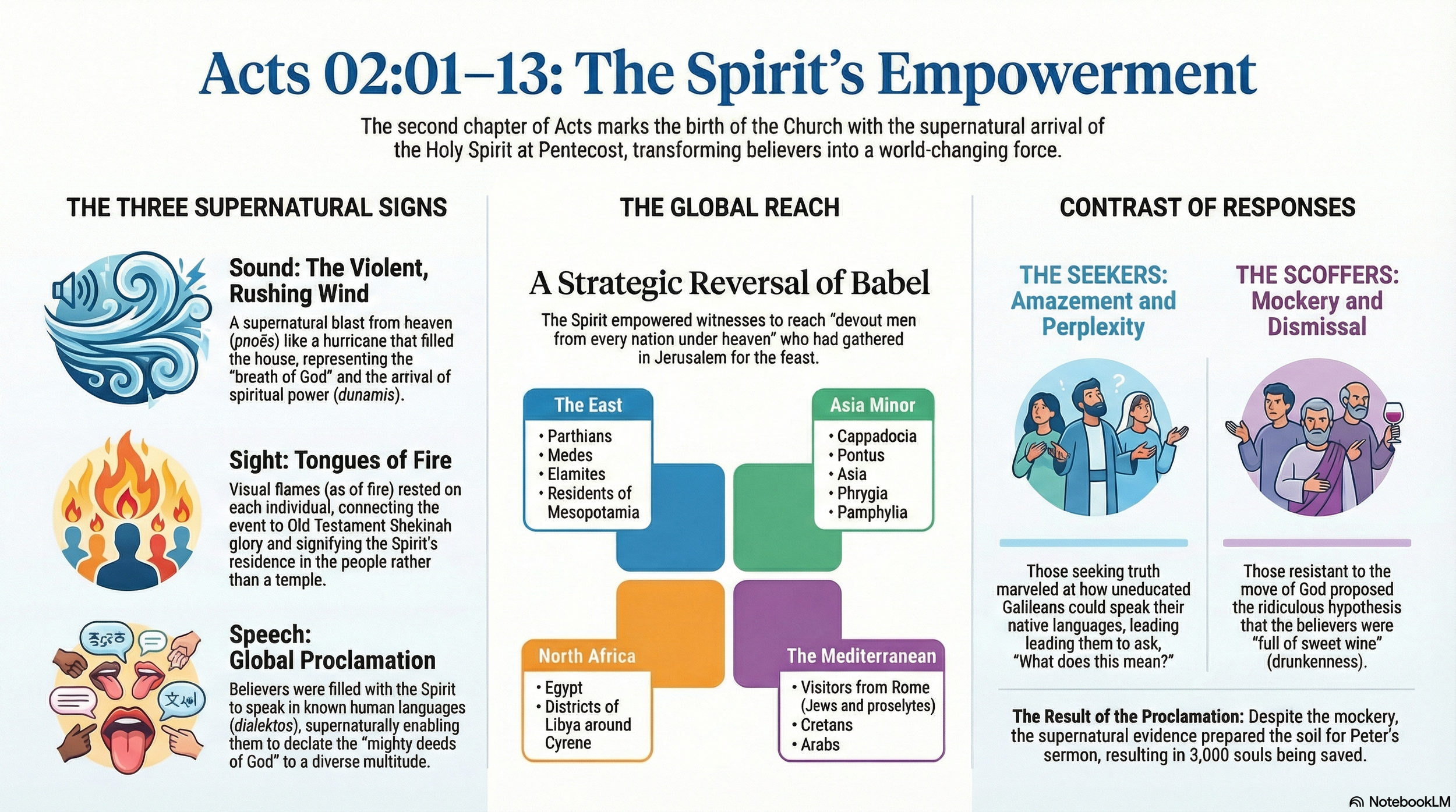
Acts 2:1–13 reveals that the church was born through a sovereign act of God on the day of Pentecost. As believers were all together in one place, a supernatural noise like a violent rushing wind descended from heaven, which filled the whole house where they were sitting. This divine arrival was accompanied by visible tongues as of fire that rested on each one of them, signifying that they were all filled with the Holy Spirit. This sudden empowerment enabled the disciples to speak with other tongues as a miraculous sign to the devout men gathered from every nation under heaven. While many were bewildered and marveled at hearing the mighty deeds of God, others were mocking, claiming the apostles were full of sweet wine. This transition unified the believers for their future testimony as the body of Jesus.
To engage in a thorough Q&A with Dr. MacArthur's research, see “Ask John” section below.
Lens Presence
Lens 2: The Holy Spirit (The Power Source) Dr. MacArthur emphasizes that the Spirit came according to a sovereign timetable. He distinguishes between the positional act of being baptized with the Holy Spirit into the body of Christ and the repeatable experience of being filled with the Holy Spirit for powerful testimony.
Lens 4: Prophecy Fulfillment (The Vertical Link) The Spirit’s arrival on the day of Pentecost aligns with the Old Testament feast cycle found in Leviticus 23. Just as Jesus rose on the day of first fruits, the Spirit came fifty days later to serve as the first fruits of the believers' inheritance.
Lens 5: Acceptance and Opposition (Institutional & Geopolitical Friction) The supernatural events triggered diverse reactions. While many were bewildered by hearing the mighty deeds of God in their own languages, others rejected the evidence through mocking, attempting to explain away the miracle as being full of sweet wine.
Lens 6: The New Testament Bridge (The Canonical Handshake) Acts 2 provides the historical foundation for doctrines in the Epistles. The baptism into one body connects this history to Paul’s teaching in 1 Corinthians 12, proving the church is a unified organism rather than a loose gathering.
Investigative Questions
"Ask John"
Pentecost marks the divine intersection of Old Testament types and New Testament reality. Dr. MacArthur proves that the Spirit’s arrival was a sovereign appointment, not a human achievement, intended to unify the church and prepare the world for the gospel.
Lens 2: The Holy Spirit (The Power Source)
How does the distinction between being filled with the Holy Spirit and the baptism with the Spirit clarify the believer's ongoing responsibility?
Why is it significant that the Spirit’s arrival was evidenced by a noise like a violent rushing wind and tongues as of fire rather than purely internal experiences?
Lens 4: Prophecy Fulfillment (The Vertical Link)
In what way does the day of Pentecost fulfill the Old Testament pattern of feasts described in Leviticus 23?
Why did the Holy Spirit choose the celebration of the first fruits of the wheat harvest to manifest the mighty deeds of God?
Lens 5: Acceptance and Opposition (Institutional & Geopolitical Friction)
Why did hearing the Galileans speak native languages cause the multitude to be bewildered and in great perplexity?
How does the charge that the disciples were full of sweet wine illustrate the persistent nature of spiritual blindness?
Lens 6: The New Testament Bridge (The Canonical Handshake)
How do the events of Acts 2 explain the unity described in 1 Corinthians 12 where all are baptized into one body?
How does the indwelling of the Holy Spirit at Pentecost validate the teaching in Romans 8 that those without the Spirit do not belong to Him?