Acts Evangelism Workshop:
Lesson #2 (Acts 3:1-26)
I. The Cultural Discernment (The Parallel)
In the 1st century, the lame man's "Alm" was a surface request that masked a sovereign need. Today, we discern the same pattern: neighbors ask for "silver and gold" (political fixes, financial security, or mental health) while remaining blind to their spiritual bankruptcy. We must look past the "Alm" to address the soul.
II. The Tactical "How" (The Execution)
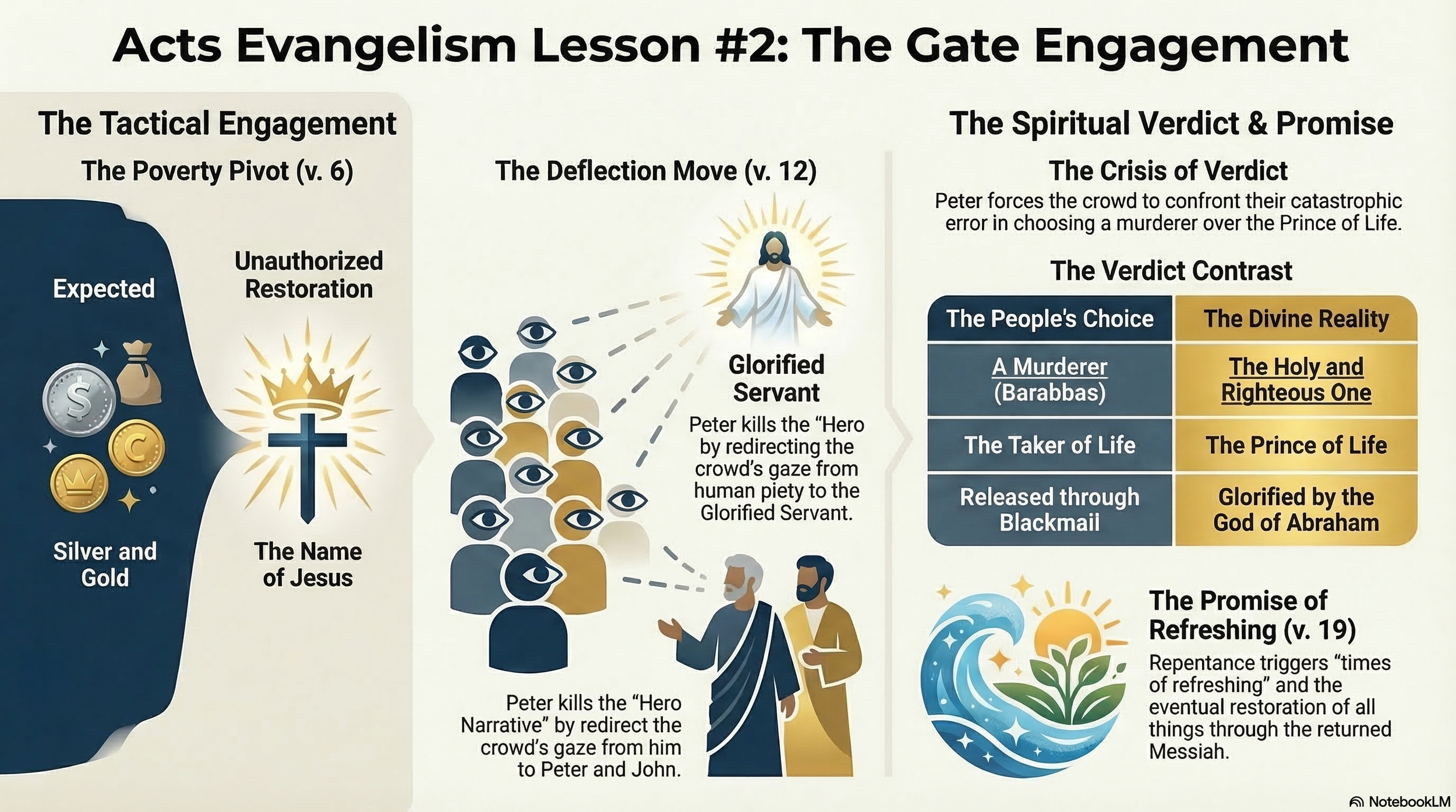
The Poverty Pivot (v. 6):
Refusing the expected charity to offer the unauthorized restoration: "I do not possess silver and gold, but what I do have I give to you: In the name of Jesus Christ the Nazarene—walk!"The Gaze Deflection (v. 12):
Immediately killing the "Hero Narrative" to focus on Christ: "Why do you gaze at us, as if by our own power or piety we had made him walk?"The Historical Anchor (v. 13):
Linking Jesus to the "God of Abraham, Isaac and Jacob" to destroy the "New Age" or "Generic Spirituality" argument.
III. The Strategic "Why" (The Logic)
The objective is Historical Specificity. By grounding the miracle in the history of the "God of the Fathers," Peter proves that Jesus is not a "new option" but the absolute fulfillment of all truth. This creates the necessary Crisis of Verdict.
Evangelism Briefing #02:
The Gate Engagement (Acts 3:1–26)
I. Engagement Overview
The Target: A crowd of religious observers at the Temple who are comfortable with "charity" but blind to the "Messiah".
The Catalyst: A supernatural restoration (The Sign) that creates an unavoidable public "Point of Inquiry".
II. The "How" (Execution Tactics)
The Poverty Pivot (v. 6): Peter refuses the "expected" charity and offers "unauthorized" restoration: "I do not possess silver and gold, but what I do have I give to you: In the name of Jesus Christ the Nazarene—walk!".
21st Century Application: When a skeptic asks for social or physical help, pivot the conversation to address their deeper spiritual bankruptcy.
The Deflection Move (v. 12): Peter immediately kills the "Hero Narrative" by shifting the focus away from human piety: "Men of Israel, why are you amazed at this, or why do you gaze at us, as if by our own power or piety we had made him walk?".
21st Century Application: Deflect the "gaze" of the audience from your own personality or abilities to the Person and power of Christ.
The Closing Call (v. 19): Peter moves from indictment to a clear command for action: "Therefore repent and return, so that your sins may be wiped away...".
21st Century Application: Do not leave the encounter at a mere intellectual agreement; demand a personal response of repentance so that spiritual "refreshing" may come.
III. The "Why" (Strategic Objectives)
Logic over Naturalism: Moving the crowd from the "Sign" (the physical healing) to the "Source" (the glorified Servant).
The Vertical Link (v. 13): Peter connects Jesus to verifiable history: "The God of Abraham, Isaac and Jacob, the God of our fathers, has glorified His Servant Jesus".
The Logic: Jesus is the Historical Fulfillment of God's plan, not a "new option." This destroys "New Age" or "Generic Spirituality" arguments.
The Explicit Indictment (v. 14–15): Peter uses eyewitness testimony to create a Crisis of Verdict: "But you disowned the Holy and Righteous One and asked for a murderer to be granted to you, but put to death the Prince of life...".
The Logic: You cannot offer the "refreshing" of the Gospel until the audience understands they have made a catastrophic legal error in their rejection of God's Servant.