
What Exactly is the Great Commission?
At its core, The Great Commission is the final instruction given by Jesus to his disciples before his ascension. Found at the end of the Gospel of Matthew (Matthew 28:18–20), it serves as the foundational mission statement for the Christian Church.
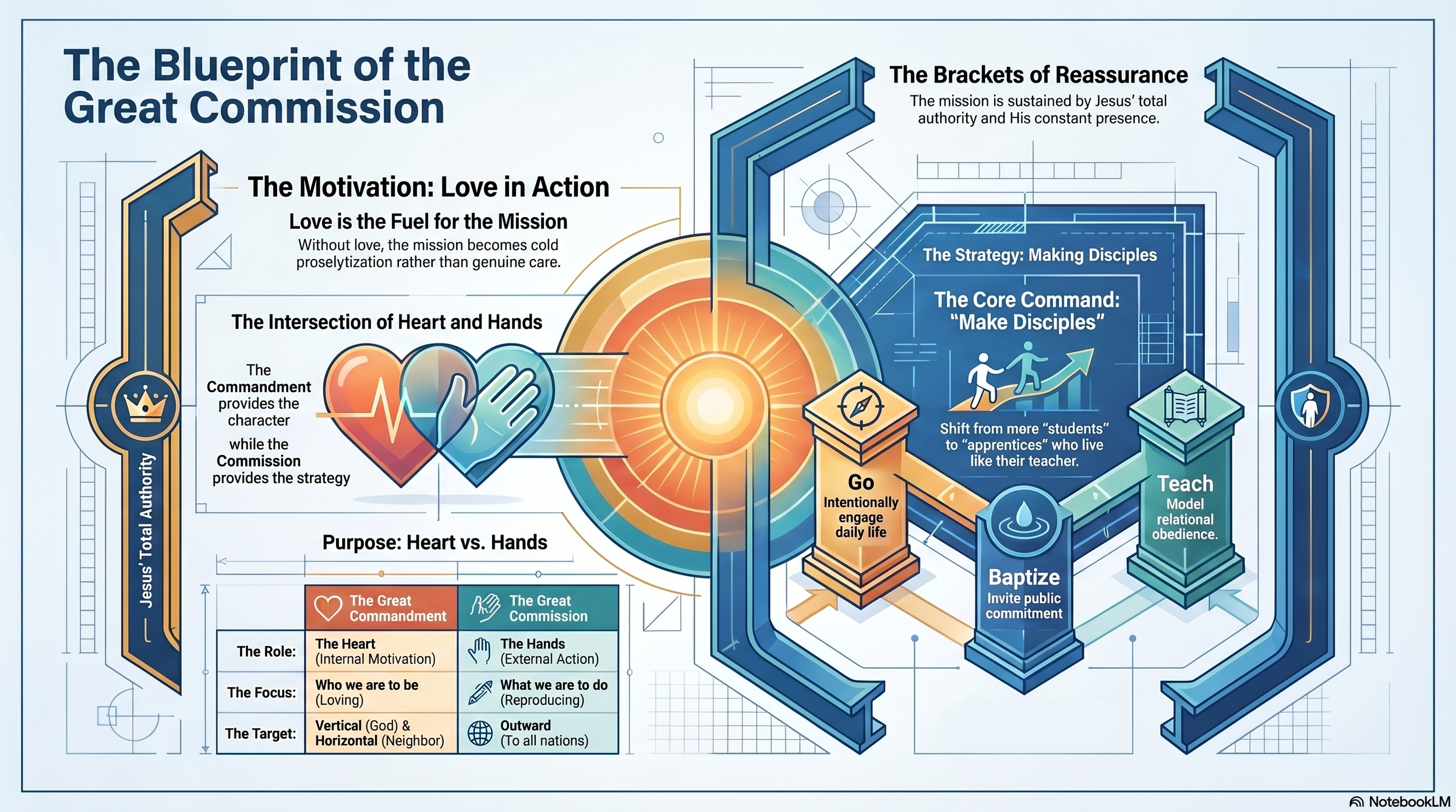
You need to know exactly what it is commanding you to do, so it helps to look at the original language. In the original Greek text, there is actually only one primary command (the main verb), supported by three action steps (participles) that explain how to fulfill that command.
Here is the exact breakdown of what you are being asked to do.
The Core Command: Make Disciples
The single primary verb in the Great Commission is "make disciples" (matheteusate).
A disciple isn't just a student who memorizes facts; it's an apprentice. In the ancient world, a disciple lived with their teacher to become exactly like them. Your core mission is not just to convert people or get them to pray a prayer, but to help them become lifelong followers and imitators of Jesus.
The Three Action Steps
The text surrounds that core command with three specific instructions that show you what making a disciple looks like in practice:
1. "Go" (The Scope)
What it means: While often translated as a direct command to pack your bags and move across the world, the Greek phrasing (poreuthentes) is more accurately understood as "as you are going" or "having gone."
The Action: It implies that your faith isn't meant to be passive or contained inside a church building. Whether you are going across the street to your neighbor, going to your workplace, or going to a different country, the command is to intentionally engage with the world around you as you live your daily life.
2. "Baptizing Them" (The Entrance)
What it means: Jesus specifies baptizing people "in the name of the Father and of the Son and of the Holy Spirit."
The Action: Baptism is the public declaration of a person's new identity in Christ and their initiation into the community of believers (the Church). In terms of what you do, this means inviting people into a formal, public commitment to Christ and helping connect them to the wider body of faith.
3. "Teaching Them to Obey" (The Maturity)
What it means: Notice that Jesus didn't say "teach them to know." He said, "teaching them to observe (or obey) everything I have commanded you."
The Action: This is the long-term, relational part of the commission. It means walking alongside someone to help them bridge the gap between head knowledge and daily practice. You are helping them align their behavior, character, and worldview with the teachings of Jesus.
The Reassurance
Jesus brackets this heavy responsibility with two massive reminders: He starts by stating that all authority in heaven and on earth has been given to Him (meaning you go under His authority, not your own strength), and He ends with the promise, "I am with you always, to the very end of the age."
In short, the "what" is a lifestyle of spiritual apprenticeship: as you live your life, you are called to introduce people to Jesus, invite them into community, and relationally help them learn how to live out His teachings.
The Great Commission &
The Great Commandment
The Great Commission and the Great Commandment are essentially the mechanism and the motivation of the Christian faith. They are entirely inseparable; one tells you what to do, and the other ensures you don't lose your soul while doing it.
When Jesus was asked what the greatest commandment in the law was, he pointed to two things: Love God completely and love your neighbor as yourself (Matthew 22:37–40).
Here is exactly how that intersects with the mission to make disciples:
1. Love is the Fuel for the Mission
Without the Great Commandment, the Great Commission easily devolves into cold, mechanical proselytization—treating people like statistics to track or "projects" to complete rather than individuals made in the image of God.
Loving God means your desire to share His message comes from a place of genuine worship and overflow, not rigid obligation.
Loving your neighbor means you care about their ultimate, eternal well-being. If you truly love someone as yourself, you naturally want to share the source of hope, peace, and transformation you've found with them.
2. Making Disciples is an Act of Love
Sharing the gospel and walking with someone to help them grow (the Commission) is actually one of the highest expressions of loving your neighbor (the Commandment). You are investing your time, your patience, and your life into their spiritual maturity. You are helping them discover their true identity and purpose.
3. Obedience is the Explicit Intersection
The final step of the Great Commission is "teaching them to obey everything I have commanded you."
If you ask what the very first and most important thing is that a new disciple needs to learn to obey, the answer is The Great Commandment. You cannot fulfill the Great Commission without teaching people how to love God and love others.
The PrincipleThe Great Commandment (Matt 22)The Great Commission (Matt 28)The RoleThe Heart (The Internal Motivation)The Hands (The External Action)The FocusWho we are to be (Loving)What we are to do (Reproducing)The TargetVertical (God) & Horizontal (Neighbor)Outward (To all nations/As you go)
In short: The Great Commandment gives the Great Commission its character, while the Great Commission gives the Great Commandment its strategy. One keeps the mission loving; the other keeps love active.